Are Term Life Insurance Rates by Age in 2026 Still the Cheapest Way to Protect Your Family?


When you look at term life insurance rates by age, what are you actually asking?
Deep down it’s usually, “How much will this cost someone like me, and am I already too late to get a good deal?”
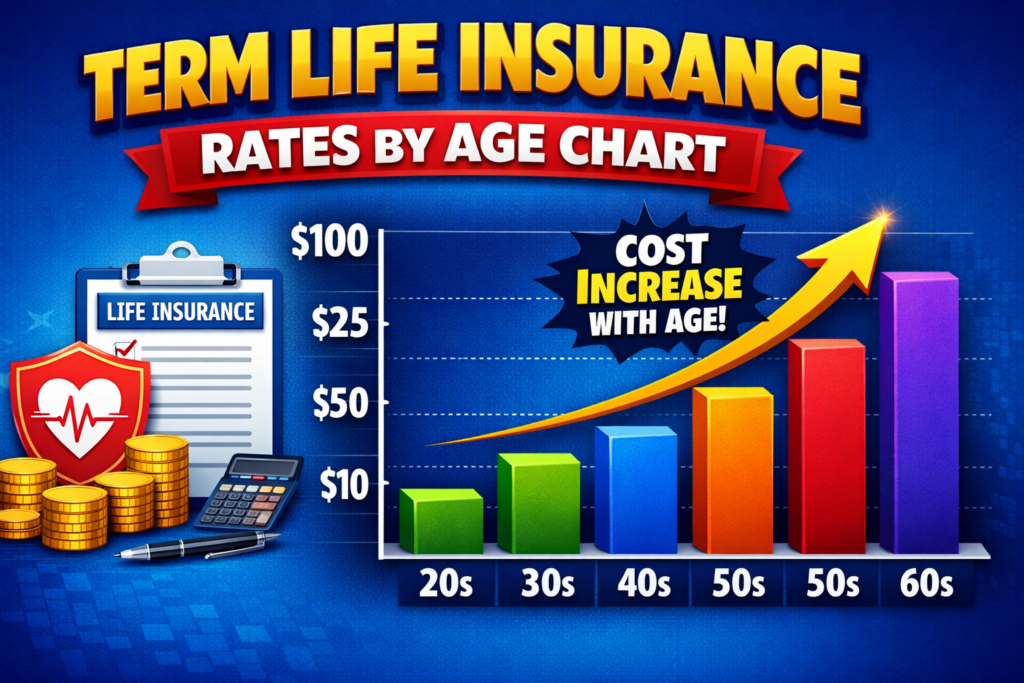
In 2026, the basic rule hasn’t changed: the younger and healthier you are when you apply, the less you’ll pay for the same term and coverage amount. Recent studies still show that term life gets noticeably more expensive every year you wait—some analyses estimate average increases of 8–12% per year just from age alone, especially term life in your 40s and 50s.
This guide breaks down term life insurance rates by age charts, shows realistic 2026 sample premiums, and explains how term length, health, and coverage amounts change what you pay. By the end, you’ll know which chart actually matters for your family—not just which one looks cheapest on a blog.
What are typical term life insurance rates by age in 2026?
In 2026, a healthy 30-year-old can often get a 20-year, $250,000 term life policy for around $15–$25 per month, a 40-year-old for roughly $25–$40, and a 50-year-old for about $45–$80, depending on health, term length, and the insurer.
What Do Term Life Insurance Rates by Age Really Tell You in 2026?
When you see a term life insurance rates by age chart, you’re not looking at a promise. You’re looking at a snapshot: a specific term length, coverage amount, health class, and sometimes a specific company’s internal pricing.
Most charts assume a healthy, non-smoking applicant in a “good” or “preferred” class. They’re meant to show how the cost of term life changes as you age and why buying earlier usually saves you a lot of money over the life of the policy. Recent data from multiple carriers and brokers still shows average term rates climbing meaningfully with each decade, even for people in good health.
If you understand what the chart assumes—and how your situation is different—you can use it as a smart planning tool instead of a misleading marketing graphic.
How Term Life Insurance Rates Are Calculated by Age, Term, and Health
Before you lean on any term life insurance rates by age chart, it helps to know the moving parts behind those numbers.
Term life rates are set using life expectancy tables, but that’s just the foundation. Carriers look at age, gender, term length, coverage amount, health, lifestyle, and underwriting class. They price in the risk that they may have to pay out the full death benefit during the term you choose.
The result is a premium that’s usually level for 10, 15, 20, 25, or 30 year terms, depending on the term. Once the level term ends, the renewal premium usually jumps sharply, which is why most people either replace or drop their policy at that point instead of riding it out at the post-level rates.
Why age is still the biggest driver of term life cost
Your age at the time of application may be the single biggest factor in determining your rate. The older you are, the fewer years the carrier expects to collect premiums, and the closer you are, statistically, to a claim.
Some analyses show that, on average, life insurance prices can increase roughly 8–12% per year as you move through your 40s and 50s, even with no major change in health. Others show that for people over 40, average rates can jump about 10% every six months in some pricing models.
In plain terms: if you know you need term life, waiting “just a year” can cost you a lot over the full term.
How term length and coverage amount change the chart
Term length and coverage amount are the second and third big levers. A 10-year term is cheaper than a 20-year term, and a 20-year term is cheaper than a 30-year term—because the company is on the hook for fewer years.
Coverage amount works the way you’d expect: $500,000 costs more than $250,000, and $1,000,000 costs more than $500,000. But the cost does not scale perfectly; you often get a better “per-dollar” price with larger face amounts.
That’s why one million dollar term life insurance can often cost less than people assume when you compare it to what’s at risk if your income disappeared.
Make sure the chart matches the *term length* and *rate class*—that’s where most people get misled. A 10-year chart can look “cheap” compared to a 20-year chart, even at the same age.
Before you trust a chart, confirm:
- Term: 10 vs 20 vs 30 years (prices are not interchangeable).
- Class: Preferred Plus / Preferred / Standard (largest pricing swing).
- Amount: $250K vs $1M (can change underwriting requirements and pricing).
- Payment: monthly vs annual (annual is often lower total cost).
Get a fast term quote — or a fully shopped pre-approved option.
Select the path you prefer. Quick ballpark pricing, or a fully shopped result emailed to you.
No pressure. No upsells. Just transparent term life options built around your family’s needs.Sample Term Life Insurance Rates by Age Charts (2026 Examples)
Before we get into numbers, keep this in mind: these are sample ranges, not quotes. Real offers will vary by carrier, health class, state, and underwriting results.
The ranges below pull from multiple public term rate examples for healthy, non-smoking applicants in good health who qualify for good classes.
20-year term life insurance rates by age for $250,000 of coverage (2026 ranges)
To keep it simple, think of a healthy non-smoking applicant looking at a 20-year term with $250,000 of coverage.
Here’s how typical monthly ranges might look:
20-Year Term • Slide Quoter ( $250,000 )
Select gender and age to view sample monthly premium for $250,000 coverage.
Get your sample quote
Your result
For Male • Age 60
$250,000: $106.25/mo
20-Year Term Sample Rate
These ranges line up with public sample tables where, for example, some major carriers show roughly $15–$20 per month for younger non-smokers and $70+ per month for 50–60-year-olds for $250,000 of coverage.
20-year term life insurance rates by age for $500,000–$1,000,000 (2026 ranges)
For families protecting income, debt, and kids all at once, $500,000 to $1,000,000 is more realistic. These ranges assume strong health and good classes.
Before the chart, remember: bigger coverage amounts usually give better “per-dollar” pricing than small policies.
20-Year Term • Slide Quoter ( $500,000 & $1,000,000 )
Step through gender and age to view sample monthly premiums.
Get your sample quote
Your results
For Male • Age 60
$500,000: $183.86/mo
Tap the table or change age to update.
| Coverage | Estimated Monthly Premium |
|---|
Industry examples regularly show a 40-year-old in good health paying around $25–$35 per month for a 20-year, $500,000 policy and roughly double that for $1,000,000, depending on the carrier.
Rates rise for two reasons: age bands and health risk—not because carriers “feel like it.” Knowing the trigger helps you choose the right timing and term length.
Most common triggers:
- Age bands: pricing often steps up at 30/35/40/45/50/55/60.
- Risk class changes: BP, A1C, cholesterol, BMI, tobacco, meds.
- Longer term: 30-year costs more than 20-year at the same age.
- Face amount: higher amounts can require stricter underwriting.
Term Life Insurance Rates By Age (Sample Chart)
Select gender, term length, and age to view sample monthly premiums for $250,000–$1,000,000 coverage.
2) Your sample rates
For Male • 10-Year • Age 20
$250,000: $9.68/mo
Tap a coverage amount below to change the highlighted premium.
| Coverage | Estimated Monthly Premium |
|---|
Want speed — or full accuracy?
TERM QUOTE: Ballpark Term quote in seconds.
PRE-APPROVED TERM QUOTE: Have a Fully Shopped Rate emailed to you – 100% Accurate.
People Also Ask About Term Life Insurance Rates by Age in 2026
These are PAA-style questions around term life insurance rates by age, written in snippet-ready format.
Yes. Term life is usually cheapest when you’re younger because your risk of death during the term is lower. As you age, premiums rise, sometimes by 8–12% per year on average through your 40s and 50s, even if your health is stable.
A healthy 30-year-old non-smoker can often get a 20-year, $250,000 term policy for around $15–$25 per month and $500,000 for roughly $20–$35 per month, depending on the insurer and underwriting class.
For a healthy 40-year-old non-smoker, common ranges are about $20–$32 per month for $250,000 and $30–$55 per month for $500,000 on a 20-year term, with higher amounts costing proportionally more.
Most charts and carrier data show premiums climbing noticeably with each decade; some sources cite around 8–12% average annual increases for many applicants, and faster jumps after age 50. Once the level term ends, renewal rates can jump dramatically.
You should buy term life as soon as someone depends on your income or you take on long-term obligations like a mortgage or kids. The earlier you buy, the lower your rate, and locking in a 20–30 year term in your 20s or 30s can save thousands over waiting.
Other Factors That Can Raise or Lower Your Term Life Rate Beyond Age
Age is big, but it isn’t everything.
Carriers also adjust term life insurance rates by age based on your:
- Health history and current conditions (blood pressure, cholesterol, diabetes, cardiac history).
- Build and BMI, using life insurance height & weight chart guidelines.
- Tobacco or nicotine use.
- Risky hobbies (aviation, scuba, climbing) or driving record.
- Family history of early cardiac events or cancer.
You can be the “right” age but still pay more if your risk profile is complicated. The reverse is also true: slightly older clients with excellent overall health and lifestyle can sometimes get better pricing than younger applicants with multiple risk factors.
How Much Term Life Coverage Should You Choose at Each Age?
A chart can show you what things cost. It can’t tell you how much you should buy.
The amount you choose should be tied to income replacement, debts, and the time your family would need to adjust. That’s why term length and coverage amount need to match your real life—not a generic rule of thumb.
Here’s a simple way to think about it:
- In your 20s and 30s, you’re often protecting future income, student loans, and young kids.
- In your 40s and 50s, you’re defending your highest earning years, a mortgage, and college costs.
- Past your mid-50s, you may be trimming coverage as debts shrink and retirement assets grow.
Articles like 30 year term life insurance cost can help you zoom in on long-term terms specifically, while mortgage protection life insurance content helps you align coverage to your payoff schedule.
The goal is simple: enough term to make sure your family’s plans can still happen if your paycheck disappears.
Term Life Insurance Rates by Age vs Whole Life and Final Expense
When you compare term life insurance rates by age to whole life or final expense, the difference is stark.
Whole life and final expense include lifetime coverage and potentially cash value. That means higher guarantees and a much higher cost per dollar of coverage. For the same death benefit, whole life can be several times the price of term, especially at younger ages.
That’s why most families use term to cover big temporary risks—mortgages, kids, income—and reserve whole life or final expense for permanent needs like legacy or burial. Content like whole life insurance rates by age charts and burial insurance for parents can help you compare the permanent side of the plan without confusing it with pure term pricing.
Term will almost always look cheaper in any “rates by age” table. The real question is whether the coverage duration matches what you’re trying to protect.
Related Articles
Use charts to estimate cost—then shop carriers to isolate your best rate class. The “best rate” is the best match for your underwriting profile.
Simple process that works:
- Step 1: Choose age + amount + term from the chart.
- Step 2: Confirm tobacco, meds, and basic health history.
- Step 3: Compare multiple carriers to find best class and best price.
- Result: Correct coverage, lowest cost, and fewer underwriting surprises.
FAQs About Term Life Insurance Rates by Age in 2026
These FAQ questions are different from the PAA set and focus on “what should I actually do?”
The term should run at least until the last major obligation you’re worried about is gone—kids are grown, mortgage is paid, or you hit financial independence. Many people in their 30s and early 40s choose 20–30 year terms so coverage lasts through kids and the bulk of the mortgage.
Shorter terms are cheaper upfront, but that strategy usually backfires. When you renew later, you’re older and may have new health issues. That can make new coverage dramatically more expensive or even unavailable. Locking in the right term now often wins over trying to “game” the length.
Laddering means stacking multiple policies with different terms so coverage gradually steps down as debts and responsibilities shrink. Done right, it can match coverage to your real needs and keep costs efficient. Done wrong, it can leave gaps or create unnecessary complexity. It’s best planned with someone who understands how your debts and income timelines actually look.
Conversion can make sense if your health changes and you want guaranteed lifetime coverage, or if you realize later you want to keep part of the benefit for estate planning or final expenses. Many policies allow conversion without new medical underwriting, but the window is limited, often by age or policy year.
Multi million dollar life insurance policy pricing follows the same age and health rules—you pay more as you age, but the “per-dollar” cost can be surprisingly efficient for high earners. The key is accurate income replacement planning and underwriting that fits your profile so you don’t overbuy or underbuy coverage.
Final Thoughts: How to Use Term Life Insurance Rates by Age to Lock In the Right Policy
At the end of the day, term life insurance rates by age are not just about finding the lowest number.
The real question is, “What do I need to protect, and for how long?”
If you’re in your 20s or 30s, this is about locking in cheap long-term protection while your health is strong. In your 40s and 50s, it’s about making sure your peak earning years, mortgage, and kids are covered if something happens. If you’re older, it may be about tightening up coverage and pairing term with targeted permanent insurance instead of trying to do everything with one product.
You don’t need noise, gimmicks, or teaser rates. You need clear numbers, honest expectations, and a plan that actually fits your life, not a stranger’s spreadsheet.
Ready for your term options?
TERM QUOTE: Ballpark Term quote in seconds.
PRE-APPROVED TERM QUOTE: Have a Fully Shopped Rate emailed to you – 100% Accurate.
More Life Insurance Resources
