Mortgage Protection Life Insurance: 2027 Guide


Mortgage protection life insurance is meant to solve one basic problem: if you die before the mortgage is paid off, can the people you love keep the home? The confusing part is that “mortgage protection” is used to describe several different products—from decreasing-term credit life tied directly to a loan to ordinary level term life purchased specifically to protect a mortgage.
That distinction matters. Some policies pay the lender and shrink with the loan balance. Others pay a beneficiary you choose and keep the death benefit level. Before you buy, identify exactly which structure you are being offered.
It can be, but the best structure is often a level term life policy sized to cover the mortgage plus other family needs. Credit life or decreasing-term mortgage coverage may be useful in specific situations, but it can be less flexible because the benefit may shrink and may be payable directly to the creditor. Compare the beneficiary, death-benefit structure, underwriting, term, and premium before deciding.
Table of Contents
- What Mortgage Protection Is
- 3 Common Structures
- Mortgage Protection vs. Term
- How Much It Costs
- Mortgage Protection Spotlight Carriers
- Mortgage Protection for Seniors
- No-Exam Options
- Refinancing or Moving
- Paying the Mortgage Off Early
- Mortgage Protection vs. PMI
- Mailers & Marketing Warnings
- How to Shop
- People Also Ask
- FAQ
What Is Mortgage Protection Life Insurance?
Mortgage protection life insurance is life insurance purchased to help cover a mortgage if the insured dies. But the product name alone does not tell you how the policy works.
The NAIC distinguishes level term from decreasing term. Level term keeps the death benefit fixed during the selected term, while decreasing term reduces the death benefit over time and is often used for obligations such as a mortgage. The NAIC also describes credit life as coverage where proceeds are paid directly to the creditor.
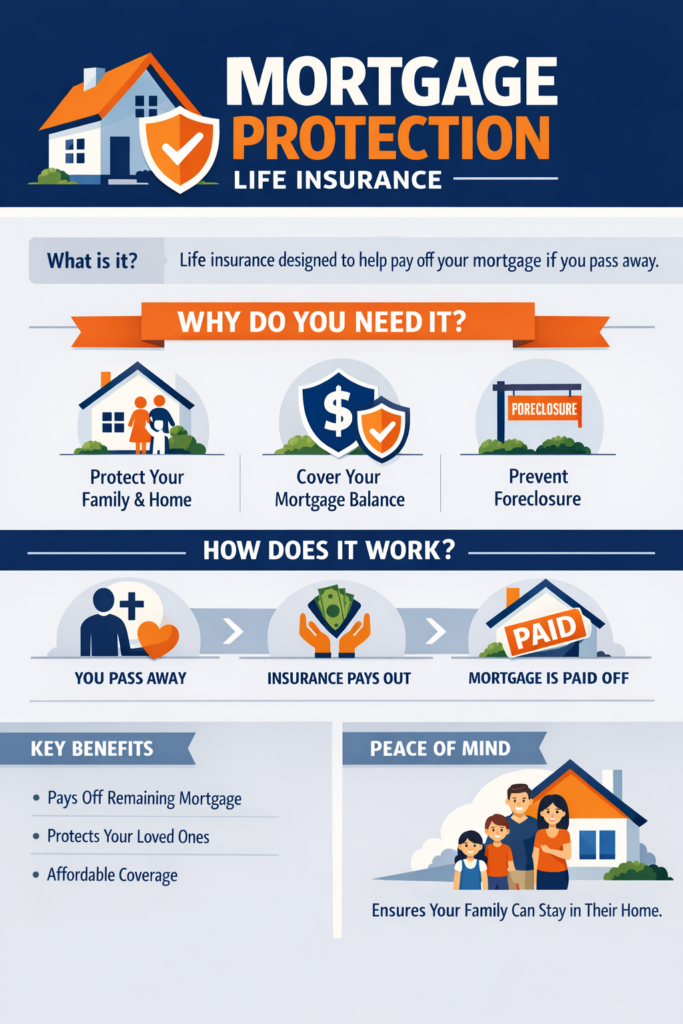
The 3 Common Ways to Protect a Mortgage With Life Insurance
1. Level Term Life
You choose a fixed death benefit and term—often 10, 20, 30, 35, or 40 years. Your named beneficiary receives the proceeds and decides whether to pay off the mortgage, keep making payments, replace income, or handle other needs.
2. Decreasing Term / Mortgage Life
The death benefit can decline over time as the mortgage balance falls. This design is focused primarily on the loan rather than broader family needs.
3. Credit Life Insurance
The creditor is the beneficiary and receives proceeds to satisfy covered debt after the insured’s death. It is optional credit insurance—not PMI.
Which Is Most Flexible?
For many healthy homeowners, level term gives the family the most control because the beneficiary receives the death benefit rather than having the policy limited to the mortgage balance.
Mortgage Protection Insurance vs. Term Life Insurance
For most homeowners, this is the most important comparison.
| Feature | Level Term Life | Decreasing Mortgage / Credit Life |
|---|---|---|
| Death benefit | Usually stays level during the selected term | May decrease as the loan balance falls |
| Beneficiary | Person, trust, or other beneficiary you name | Credit-life designs generally pay the creditor; other mortgage-protection designs vary |
| Use of proceeds | Beneficiary controls how proceeds are used | May be restricted primarily to satisfying the covered mortgage/debt |
| Coverage if you move | Personally owned term generally stays with you as long as the policy remains in force | Loan-specific coverage may need review or replacement when the debt changes |
| Income replacement | Can cover mortgage plus family income needs | Usually focused primarily on the debt |
| Underwriting | Traditional, accelerated, or simplified depending on carrier | Varies widely by product |
The NAIC notes that term life is designed to provide lower-cost protection for a specific period, and it specifically lists a mortgage as an example of a temporary financial obligation that term insurance can cover. citeturn708627search0turn708627search3
Compare our 20-year term life insurance rates by age, 30-year term life insurance, and $1 million term life insurance guides.
Start with a ballpark term quote, then use the risk assessment if you want the case matched to carriers based on health and underwriting. Final eligibility and pricing are determined by the insurer.
How Much Does Mortgage Protection Life Insurance Cost?
There is no single mortgage-protection rate because the phrase covers different products. Premiums can depend on age, health, tobacco or nicotine use, coverage amount, term length, underwriting class, state, and whether the policy is level term, decreasing term, or credit life.
For that reason, this article does not use a calculator that automatically assumes mortgage protection costs 25%, 35%, or 60% more than term. That kind of multiplier is not a carrier quote and can mislead consumers.
| Factor | Effect on Cost |
|---|---|
| Age | Rates generally rise as issue age increases. |
| Health | Medical history, prescriptions, build, blood pressure, diabetes, cardiac history, cancer history, sleep apnea, and other factors can affect class or eligibility. |
| Tobacco / Nicotine | Can materially increase term-life premiums. |
| Coverage amount | A $500,000 death benefit costs more than $250,000, though pricing is not perfectly linear. |
| Term length | Longer level terms generally cost more because the insurer guarantees the rate for more years. |
| Underwriting path | Accelerated, simplified, and traditional underwriting can produce different eligibility and pricing. |
Sample Mortgage Protection Term Life Rates
These are carrier-published sample level-term rates that can be used for mortgage-protection planning. They are not PinnacleQuote quotes, and they should not be treated as guaranteed pricing. Actual premiums depend on age, sex where permitted, health, underwriting class, tobacco or nicotine use, state, face amount, term length, and carrier.
$250,000 Level Term — 40-Year-Old Male, Excellent Health
| Level Term | Sample Monthly Premium | Sample Annual Premium |
|---|---|---|
| 10 Years | $12.11 | $145.32 |
| 15 Years | $13.04 | $156.48 |
| 20 Years | $17.26 | $207.12 |
| 25 Years | $24.14 | $289.68 |
| 30 Years | $27.94 | $335.28 |
| 35 Years | $34.66 | $415.92 |
| 40 Years | $60.56 | $726.72 |
Banner Life OPTerm sample rates published for a 40-year-old male nonsmoker in excellent health with $250,000 of coverage. Sample rates dated January 15, 2026. Premiums include the carrier’s stated assumptions and are for illustration only.
$500,000 30-Year Term — Preferred Plus Non-Tobacco Samples
| Age | Female Sample | Male Sample |
|---|---|---|
| 25 | $22.45 | $27.57 |
| 35 | $28.72 | $34.22 |
| 45 | $59.26 | $76.59 |
Banner Life OPTerm 30 sample monthly premiums for Preferred Plus Non-Tobacco applicants. Carrier material states sample rates should not be used as a substitute for an actual quote.
$200,000 30-Year Mortgage Protection Example — Assurity
Assurity’s current Mortgage Protection Term Life brochure gives this carrier illustration:
| Profile | Coverage | Term | Sample Monthly Premium |
|---|---|---|---|
| Female, age 35, Standard Non-Tobacco | $200,000 | 30 Years | $33.93 |
Assurity brochure illustration. Product availability, rates, underwriting, and features vary by state and applicant. Use an actual carrier quote before applying.
Banner Life currently publishes 2026 sample term rates and states that OPTerm is available in 10-, 15-, 20-, 25-, 30-, 35-, and 40-year durations, subject to eligibility. Protective also currently offers 10- through 40-year Classic Choice term options. These are examples of ordinary level term policies that can be used to protect a mortgage without tying the death benefit directly to the loan. citeturn853277search5turn853277search0
Mortgage Protection Spotlight: Carriers We Currently Compare
For mortgage protection, we do not limit the conversation to a lender-tied product. We compare level term and other life-insurance designs that can protect the home while giving the family control over the death benefit.
Foresters Financial
Foresters’ Protecting the Family Home concept uses term insurance as the typical starting point, with 10- to 30-year terms, while also allowing layered term/permanent designs or lifetime permanent coverage depending on the client’s goals.
The concept specifically considers more than the loan balance: property taxes, homeowners insurance, maintenance, utilities, repairs, and emergency funds can all matter when deciding how much protection the family actually needs.
American-Amicable
Term Made Simple offers 10-, 15-, 20-, and 30-year level-premium periods, with coverage renewable on an annually increasing basis to age 95 after the initial level period.
The carrier brochure specifically lists paying off a mortgage, education, spouse income, and final needs as possible uses of the death benefit. It also offers conversion privileges and multiple optional or included living-benefit riders, subject to state and policy terms.
Assurity
Assurity markets its term product directly for mortgage protection. Its current brochure uses 10-, 15-, 20-, and 30-year terms and explains that the family can use proceeds to continue mortgage payments or pay off the loan—whichever works best for them.
Eligible applicants may qualify through accelerated underwriting without a medical exam, and the carrier offers optional riders such as return-of-premium and family coverage, subject to availability.
Why We Shop the Case
These carriers do not price every age, health history, medication, build, or tobacco profile the same way. The mortgage balance tells us how much protection may be needed; the health profile helps determine which carrier is likely to be the better fit.
Shop first. Apply second.
| Carrier | Mortgage-Protection Angle | Term / Design | Notable Features From Current Materials |
|---|---|---|---|
| Foresters Financial | Protect mortgage or protect home equity | Term 10–30 years; layered or permanent alternatives may also be considered | Family-home fact finder; considers mortgage plus ongoing homeownership costs; accelerated death benefit options subject to eligibility. |
| American-Amicable | Level term death benefit can be used for mortgage plus broader family needs | 10-, 15-, 20-, 30-year level premium periods | Conversion privilege; renewability to age 95; terminal, chronic, confined-care, disability and other rider options subject to state/product terms. |
| Assurity | Term Life marketed specifically for mortgage protection | 10-, 15-, 20-, 30-year terms | Accelerated underwriting for eligible applicants; optional return-of-premium and family riders; renewable to age 95. |
Banner Life and Protective for Health-Challenged Mortgage Protection Cases
Mortgage protection is ultimately a life-insurance underwriting decision. A carrier that looks inexpensive on a generic rate chart may not be the most competitive carrier once diabetes, cardiac history, cancer history, sleep apnea, elevated build, medications, or other higher-risk factors are considered.
Banner Life and Protective are two carriers we may consider when the applicant has health issues or needs a more traditional fully underwritten term solution. Both offer long-duration level-term products that can be structured around a mortgage, but their real value is that their underwriting approach may fit certain medical profiles differently than Foresters, American-Amicable, or Assurity.
That is why we do not automatically send every mortgage-protection applicant to the same company. The best carrier is the carrier that fits your health profile—not the carrier with the cheapest advertisement.
Mortgage Protection Insurance for Seniors
Seniors can still have a legitimate mortgage-protection need, especially after refinancing, buying later in life, downsizing with a new loan, or carrying a mortgage into retirement.
The challenge is that long term lengths become harder to obtain at older ages. A 70-year-old may still have term options, but a 30-year term generally will not be available. Shorter terms, permanent coverage, or a combination of life insurance and existing assets may be more realistic.
For older homeowners, compare senior term life insurance rates by age and affordable life insurance for seniors.
Can You Get Mortgage Protection Insurance With No Medical Exam?
Yes. Some term policies use accelerated or simplified underwriting and may not require a traditional paramedical exam for eligible applicants. That does not mean “no underwriting.” Carriers may still review health questions, prescription history, MIB information, motor vehicle records, electronic medical data, and other sources.
Applicants with more complex health histories may be moved to traditional underwriting or may fit a different carrier better. See our no-exam life insurance guide and high-risk life insurance guide.
What Happens to Mortgage Protection Insurance if You Refinance or Move?
This depends on what you bought.
If you own a normal level term life policy, the life insurance generally remains in force even if you refinance, pay off the mortgage, sell the home, or move—because the policy insures your life, not the specific mortgage.
If the coverage is credit life or directly tied to a particular loan, refinancing or replacing the debt may change the need or terminate the connection to that loan. Review the contract before assuming the coverage follows you automatically.
What If You Pay Off the Mortgage Early?
With personally owned level term life, paying off the mortgage early does not normally cancel the policy. You can keep the coverage for other family needs, subject to the policy terms.
With decreasing-term or credit-life coverage tied specifically to the loan, paying off the debt can eliminate or materially change the purpose of the coverage. Ask the insurer or creditor what happens before paying for a policy that is tied directly to the mortgage.
Mortgage Protection Life Insurance vs. PMI
These are completely different products.
Private mortgage insurance (PMI) protects the lender if the borrower defaults. It does not provide a life insurance death benefit to your family. The CFPB states plainly that mortgage insurance protects the lender, not the borrower. citeturn946031search0
Mortgage protection life insurance is life insurance intended to address the mortgage after death. Depending on the structure, proceeds may go to your named beneficiary or directly to a creditor.
Mortgage Protection Mailers: What Should You Watch For?
Homeowners often receive mailers shortly after closing, refinancing, or recording a mortgage. Some use official-looking formatting, urgent deadlines, lender names, government-style language, or phrases such as “final notice” and “state regulated.”
The FTC warns consumers to review mortgage-related mailers carefully because some marketing pieces are designed to look as if they came from a mortgage company or government agency when they did not. citeturn708627search5
See our explanation of “state-regulated” insurance marketing for a similar consumer-protection issue.
How to Shop for Mortgage Protection Without Overpaying
- Start with the mortgage balance and years remaining. Know the debt you are protecting.
- Calculate the family’s total need. Mortgage protection may not be enough if survivors also need income replacement, childcare, education funding, or money for other debts.
- Compare level term against any decreasing-term or credit-life offer. Use the same starting death benefit and similar duration.
- Identify the beneficiary. Know whether your spouse/family or the creditor receives the death benefit.
- Check whether the benefit stays level or declines.
- Review underwriting. No-exam convenience can be valuable, but do not assume it is automatically the best-priced option.
- Shop multiple carriers before applying. Different insurers can treat the same health history very differently.
Use our term life needs analysis calculator to estimate the broader family need before deciding how much coverage to buy.
People Also Ask About Mortgage Protection Insurance
Is mortgage protection insurance worth it?
It can be when the policy structure fits the homeowner’s need and health profile. For many healthy homeowners, level term life is more flexible because the death benefit stays level and the family controls the proceeds. Credit-life or decreasing-term mortgage coverage may still fit certain borrowers.
What is the best mortgage protection insurance?
There is no universal best policy. Compare level term, decreasing term, and credit-life structures based on the beneficiary, death-benefit pattern, term length, underwriting, carrier strength, conversion features, riders, and premium.
What are the best mortgage protection insurance companies?
The best company depends on the applicant. Banner and Protective currently offer long-duration term options that can fit mortgage needs, while other carriers may price certain medical histories more favorably. Compare carriers before applying rather than choosing from a generic ranking.
Does mortgage protection insurance pay off the house?
Some policies are designed specifically to pay the remaining mortgage balance or creditor. A personally owned level term policy instead pays the named beneficiary, who can choose whether to pay off the mortgage or use the money for other family needs.
Is mortgage protection insurance required?
Life insurance for mortgage protection is generally voluntary. It should not be confused with mortgage insurance such as PMI, which lenders may require in certain loan situations. NAIC guidance states that lenders generally cannot deny credit because a borrower refuses optional credit insurance, except for PMI requirements. citeturn946031search1
Can seniors get mortgage protection insurance?
Yes, but options narrow with age. Seniors may qualify for shorter term periods, permanent life insurance, or other structures depending on health, loan balance, state, and how long protection is needed.
Mortgage Protection Life Insurance FAQ
Is mortgage protection the same as mortgage life insurance?
Is mortgage protection the same as PMI?
Who receives the death benefit?
Can I keep the policy after the mortgage is paid off?
What if I already have enough life insurance?
Should I buy coverage equal to my mortgage balance?
Bottom Line: Protect the Family, Not Just the Loan
Mortgage protection can be useful, but the label alone tells you very little. The real question is whether the policy protects the household in the way you intend.
For many homeowners, a properly structured level term policy provides the strongest combination of flexibility, beneficiary control, and coverage that can outlast changes to the mortgage. For others—especially certain health profiles or credit-life situations—a different structure may make sense.
The best carrier is the carrier that fits your health profile—not the carrier with the cheapest advertisement. Shop first. Apply second.
Use a ballpark quote for speed or complete the Term/GUL risk assessment so your health profile can be matched across appropriate carriers. Final rates and eligibility are determined by the insurer.
Sources & Review Method
Reviewed October 26, 2026 for 2027 planning. Consumer definitions were checked against current NAIC, CFPB, and FTC guidance. Current term-product examples were checked against carrier materials from Banner Life and Protective. Policy availability, issue ages, underwriting, riders, rates, and state rules can change; the issued policy controls.
- NAIC — Life Insurance
- NAIC — Credit Insurance
- CFPB — What Is Mortgage Insurance?
- FTC — Shopping for a Mortgage FAQs
- Foresters Financial — Protecting the Family Home, 505558 US 07/25 (carrier concept guide supplied for review)
- American-Amicable Group — Term Made Simple, Policy Form 3228 (carrier brochure supplied for review)
- Assurity — Mortgage Protection Term Life Insurance, Rev. 07/26 (carrier brochure supplied for review)
- Banner Life — OPTerm
- Protective — Classic Choice Term
