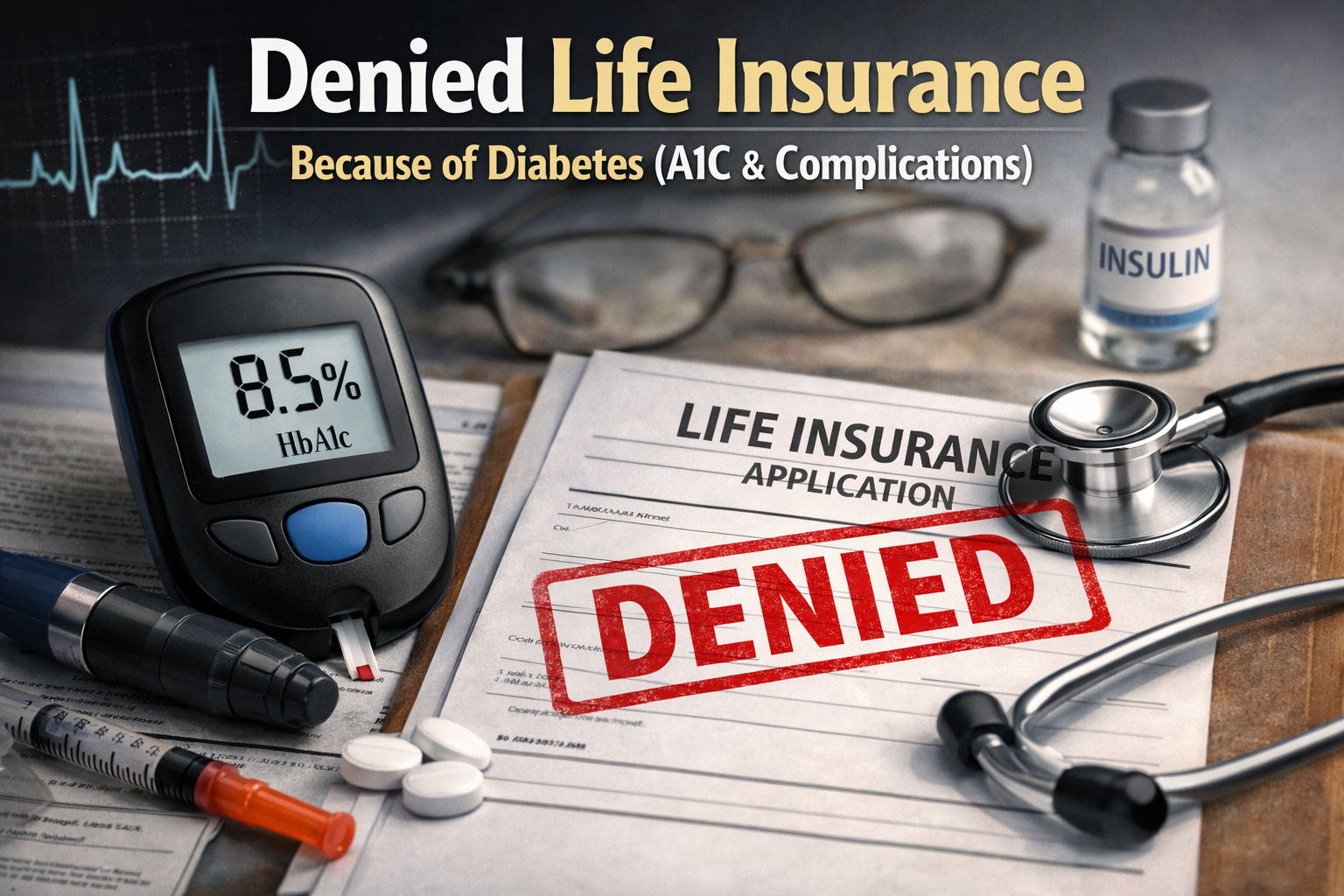
Denied life insurance because of diabetes in 2026—are you really “uninsurable”?


Denied life insurance because of diabetes is usually searched right after someone gets a “declined” notice—or hears diabetes makes coverage impossible.
What you’re really asking is: “Is this the end… or did I just apply to the wrong company?” In 2026, most people with diabetes can still get life insurance, but results depend on A1C, treatment consistency, type (1 vs 2), and complications—and carrier rules vary widely.
That’s why the smartest move is to shop your profile first instead of assuming you’re declined forever. With our process, you complete a quick risk assessment, and we shop carriers nationwide and email you the best options before you ever waste time on another application.
Why was I denied life insurance because of diabetes?
A diabetes denial usually comes down to risk signals—high A1C, inconsistent treatment, insulin use, recent hospitalizations, or complications (kidney, heart, neuropathy, eye disease). Many diabetics can still qualify, but results vary by carrier. The fastest fix is to shop multiple companies and apply where your profile fits best.
Why diabetes triggers denials (the real underwriting reasons)
A life insurance with pre-existing conditions or a diabetes diagnosis alone doesn’t automatically disqualify you. What insurers care about is control and consequences—how well it’s managed and whether it’s causing other problems.
A1C and stability
Underwriters commonly put heavy weight on A1C levels, treatment consistency, and overall stability—not the label “diabetes.”
If your A1C is trending down and records show consistent care, many carriers become much more workable.
Type 1 vs Type 2
Type 2 diabetes often has more carrier options and more favorable pricing than Type 1 when well-controlled, but both can be insurable. (Type 1 and Type 2 diabetes life insurance options)
Complications that change everything
Denials are more likely when diabetes is paired with complications like kidney impairment, cardiovascular disease, neuropathy, or significant eye disease. This is where shopping carrier “niches” matter most.
The #1 mistake: applying to the wrong carrier first
Many people assume a decline means “no one will take me.” That’s usually false. A denial often means: this carrier’s rules didn’t fit your profile.
Different companies underwrite diabetes differently, and some programs are built specifically around A1C, treatment patterns, and complication severity.
This is exactly why shopping first matters. If we know your A1C range, meds (including insulin), diagnosis age, and complications, we can aim your application where your odds are best.
Diabetes Underwriting Snapshot
Quick educational guide for likely underwriting direction based on A1C, insulin use, and diabetes-related complications.
Likely path: Best case / Standard consideration
More FavorableWell-managed diabetes with an A1C under 7 and no insulin or complications is generally the most favorable path. Final outcome still depends on age, duration, build, blood pressure, other medications, and overall health profile.
What this usually points to
- Possible Standard consideration, and sometimes better with strong overall health.
- Expect underwriting questions about diagnosis date, control method, physician follow-up, and labs.
- No complications helps keep the case more competitive.
What helps the case most
- Recent A1C available
- Consistent medical follow-up
- No neuropathy, retinopathy, kidney disease, or cardiac history
What to do after a diabetes denial (step-by-step)
Here’s the practical playbook.
1) Get the decline reason (in writing if possible)
Ask what specifically triggered the decline: A1C, a recent hospitalization, complications, or a documentation gap. Some denials are simply “insufficient information.”
2) Check your MIB file
If your application was declined, it can help to review your Medical Information Bureau (MIB) record so you know what insurers may see in future applications. (This is commonly recommended by diabetes-focused insurance resources.)
3) Choose the right re-apply strategy
- If the issue is timing (recent diagnosis change, recent hospitalization, A1C spike), waiting and showing stability can help.
- If the issue is carrier fit, you may be able to apply immediately elsewhere with better odds.
What options still exist
You usually have more than one lane.
Fully underwritten term or permanent (best value if you qualify)
If your diabetes is stable and complications are minimal, fully underwritten coverage can offer the best long-term value. Many carriers evaluate A1C, smoking, meds, and other health factors in a structured way.
Simplified issue (faster decisions)
This can work when you want speed and fewer requirements, but pricing can be higher.
Guaranteed issue (last resort)
Guaranteed acceptance whole life exists for people who don’t want health questions, but these policies commonly come with graded benefits early on and lower coverage limits.
See Which Carriers May Fit Your Diabetes History
Start with our diabetes risk assessment so we can review your situation, shop multiple carriers, and email you the best match based on your health profile.
Answers to popular questions about diabetes denials
Common Questions About Being Denied Life Insurance Because of Diabetes
Can you get life insurance if you were denied for diabetes?
Yes. A prior denial doesn’t mean you’re uninsurable—carrier rules vary. Many people get approved later by applying to a carrier that better fits their A1C, treatment plan, and complication profile.
What A1C is “too high” for life insurance?
There isn’t one universal cutoff. Insurers generally focus on A1C level and stability, plus complications. Some carriers are more flexible than others, which is why shopping matters.
Does insulin automatically cause a decline?
Not automatically. Insulin can increase perceived risk, but many carriers still offer coverage based on control, history, and complications. It’s a rating/eligibility factor—not a guaranteed decline.
How long should you wait to reapply after a denial?
It depends on why you were declined. If it was a temporary issue (recent hospitalization or unstable readings), showing stability over time can help. If it was carrier fit, you may be able to apply elsewhere sooner.
Can you be denied during the first two years because of diabetes?
If diabetes or related history was misrepresented on the application, insurers can investigate and potentially deny/rescind during the contestability period. Accuracy matters.
Related Articles
Denied Life Insurance Because of Diabetes?
A diabetes decline does not always mean you are uninsurable. In many cases, the real issue is not just diabetes itself. It is how the carrier views your A1C, control history, medication use, and any complications such as neuropathy, kidney issues, heart disease, or prior hospitalizations.
Many people are declined by one company and still approved by another. The right carrier fit can make a major difference.
Why a Decline Happens
Carriers may get cautious when diabetes looks uncontrolled, recently changed, poorly documented, or tied to other health risks.
What Underwriters Review
They often look at A1C trends, age at diagnosis, insulin use, build, blood pressure, medications, and related impairments.
Why Shopping Matters
One carrier may decline while another may offer Standard or table-rated coverage depending on the full picture.
What Helps vs. What Raises Red Flags
What Can Help
- Stable A1C history over time
- Good medication compliance
- No recent diabetic hospitalizations
- No major complications
- Strong follow-up with primary doctor or specialist
Common Red Flags
- Very elevated or worsening A1C
- Neuropathy, nephropathy, or retinopathy
- Kidney disease or protein in urine
- History of heart attack, stroke, or vascular disease
- Frequent medication changes or poor compliance
Three-Step Next Move
Review the Full Health Picture
Look beyond the decline letter. A1C, complications, build, blood pressure, and cardiac history all matter together.
Match the Right Carrier
Different carriers treat diabetes differently. Some are much better for certain A1C ranges or complication histories.
Do Not Assume You Are Declined Everywhere
A past decline should be a signal to shop smarter, not stop looking. The structure of the case matters.
FAQ
FAQs About Denied Life Insurance Because of Diabetes
Recent A1C results, medication list, physician notes showing stable management, and any specialist follow-ups can strengthen a case because underwriting emphasizes stability and consistency.
Term is possible for many diabetics, especially when well-managed. The best product depends on your goals, age, and what you can qualify for at a fair rate.
Yes. Final expense can be an alternative when coverage amounts are smaller and you want simpler underwriting, though pricing varies by health profile.
Never guess or hide health history, tobacco/nicotine use, meds, or recent care. During the contestability period, application accuracy is a common trigger for claim disputes.
Shop your profile first. A quick risk assessment lets you match to the right carrier before you submit an application—so you’re not “testing” random companies with your record.
Next step
Get the right quote by starting with your diabetes risk assessment.
Do not guess which carrier may say yes. Start with our diabetes risk assessment so we can shop carriers for you and email your best match based on your health history, medications, and overall profile.
- Annuities & Retirement Income
- Business & Key Person Life Insurance
- Final Expense & Burial Insurance
- High-Risk & Medical Conditions
- Informational
- Life Insurance
- Life Insurance Companies & Reviews
- Life Insurance Guides & FAQs
- Senior Life Insurance
- Term Life Insurance Quotes, Rates & Guides | PinnacleQuote
